Send more traffic to what's winning, while the test runs.
For promotions and short campaigns: Benchmyrk moves traffic toward the better variant and keeps a minimum share on every one.
Fixed split or auto-allocate?
Best for
Fixed split
A clear answer about what works, to keep and build on.
Auto-allocate
Promotions and short campaigns, where revenue during the test matters most.
Traffic
Fixed split
The split you set, for the whole test.
Auto-allocate
Even at first, then moved toward the variant most likely to be best.
Results
Fixed split
Chance to beat control, 95% intervals and p-values.
Auto-allocate
Each variant's chance of being best and expected loss; no p-values.
Speed to a firm answer
Fixed split
Faster: every variant keeps its full share.
Auto-allocate
Slower: weaker variants get less traffic, so they take longer to rule out.
| Fixed split | Auto-allocate | |
|---|---|---|
| Best for | A clear answer about what works, to keep and build on. | Promotions and short campaigns, where revenue during the test matters most. |
| Traffic | The split you set, for the whole test. | Even at first, then moved toward the variant most likely to be best. |
| Results | Chance to beat control, 95% intervals and p-values. | Each variant's chance of being best and expected loss; no p-values. |
| Speed to a firm answer | Faster: every variant keeps its full share. | Slower: weaker variants get less traffic, so they take longer to rule out. |
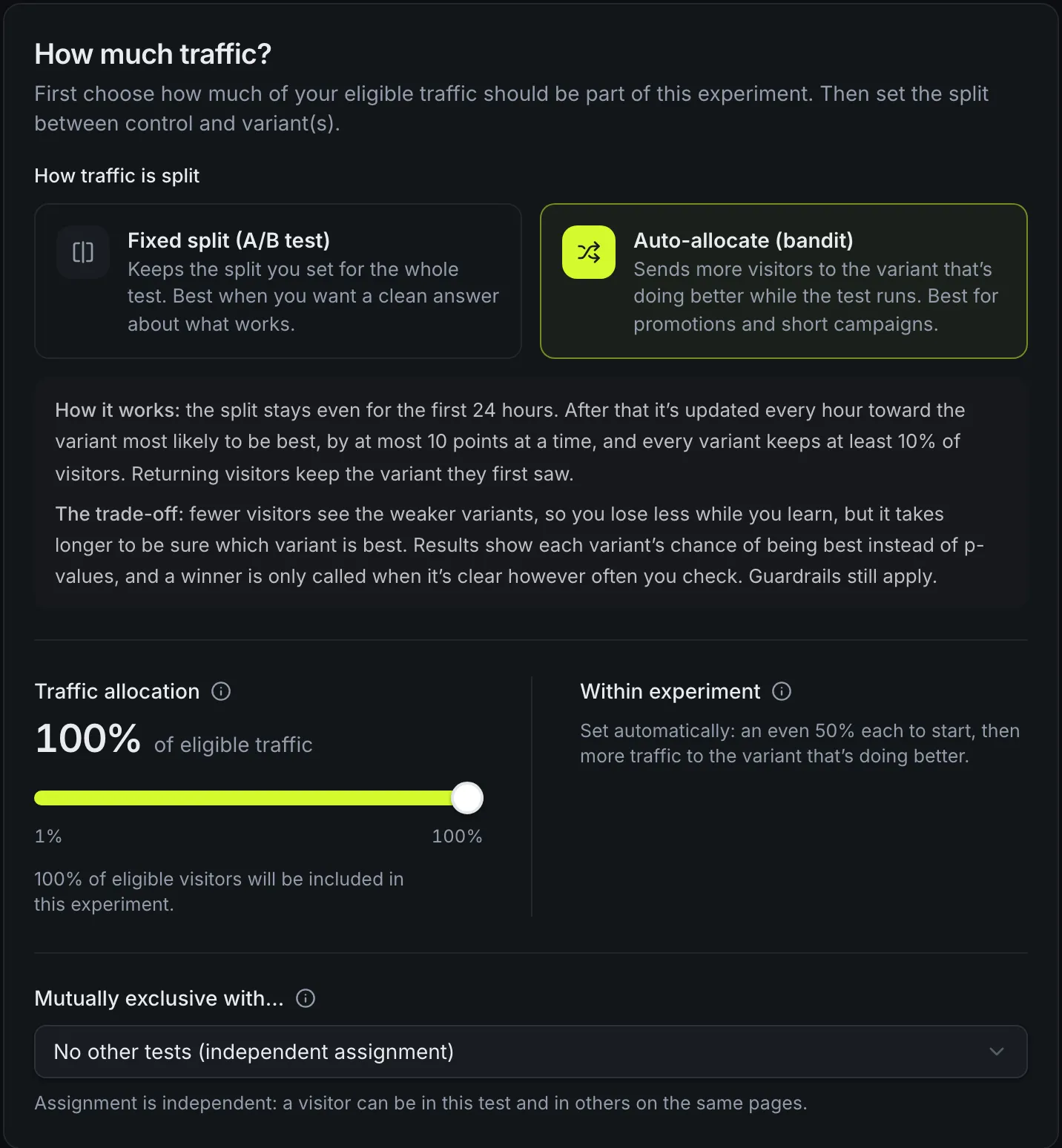
How the split moves
- 01
Warm-up
An even split until the warm-up has passed (24 hours by default, 6 to 72) and every variant has 100 visitors, plus 5 buyers on revenue goals.
- 02
Hourly updates
Each hour the split moves toward each variant's chance of being best, by at most 10 points per variant.
- 03
A minimum share
Every variant keeps at least 10% of visitors by default (5% to 25%), so the evidence keeps coming in.
- 04
Returning visitors stay put
A visitor keeps the variant they saw first; only new visitors follow the new split.
A leader is called only when it's clear
Checking "chance of being best" every hour finds false leaders: in our simulated A/A tests, a 95% rule picked a leader in about half of the runs where the variants were equal. So Benchmyrk calls a leader only when its anytime-valid confidence sequence lies above every other variant's, which holds however often anyone looks.
- In the same simulation the rule called no false leader in 300 of 300 runs.
- The sample ratio check accounts for the changing split, so a moving split isn't mistaken for a broken one.
- Guardrails, staged rollouts, mutually exclusive groups and approvals work as for any test.
Good to know
- Works with A/B, split URL and multi-page tests.
- CUPED variance reduction isn't available with auto-allocation.
- The model assumes each variant's rate is stable during the test. Strong time-of-day or weekday swings can bias results; the warm-up and the 10-point cap limit this.
- Profit goals hold the split until product costs are complete enough to judge profit.
Questions
Why are there no p-values for auto-allocated tests?
The split depends on the results so far, which biases p-values and frequentist intervals. The Bayesian estimates stay valid, so results show each variant's chance of being best, its credible interval and expected loss.
When should I use a fixed split instead?
When a firm answer matters more than revenue during the test. Auto-allocation spends most traffic on the leader, so it takes longer to rule out the weaker variants.
Can I change the minimum share or warm-up?
Yes, before the test starts: a minimum share of 5% to 25% per variant and a warm-up of 6 to 72 hours.
Running a promotion soon?
We'll show how auto-allocation behaves on demo data and when a fixed split is the better choice. Or install the Shopify app and try it.